
Language: Deutsch · English
 Structure definition
Map CSV columns to BO fields – import modes, Groovy calculation, format and identifiers.
REFERENZ APPLICATION DEVELOPER UPDATED: JUL 2026 APPLIES TO NUCLOS 4.2026.X
On this page
Why a structure definition?
The structure definition maps the columns of a source file (CSV) to the fields of a business object. Menu: Configuration → Import & Export → Structure definition.
Basic settings
| Field | Meaning |
|---|---|
| Name | name of the structure definition. |
| Header rows | number of rows to ignore (e.g. column headings). |
| Import mode | standard import (with Nuclos storage mechanisms and rules) or direct import (straight into the DB, without rules). |
| Field separator | column separator of the CSV (usually ;). |
| Business object | target BO of the import. |
Insert/update behaviour
| Option | Effect |
|---|---|
| Insert records only | always creates a new record; uniqueness violations cause errors. |
| Update existing records | existing records (by identifier) are updated. |
| Delete records no longer present | records missing from the import file are removed. |
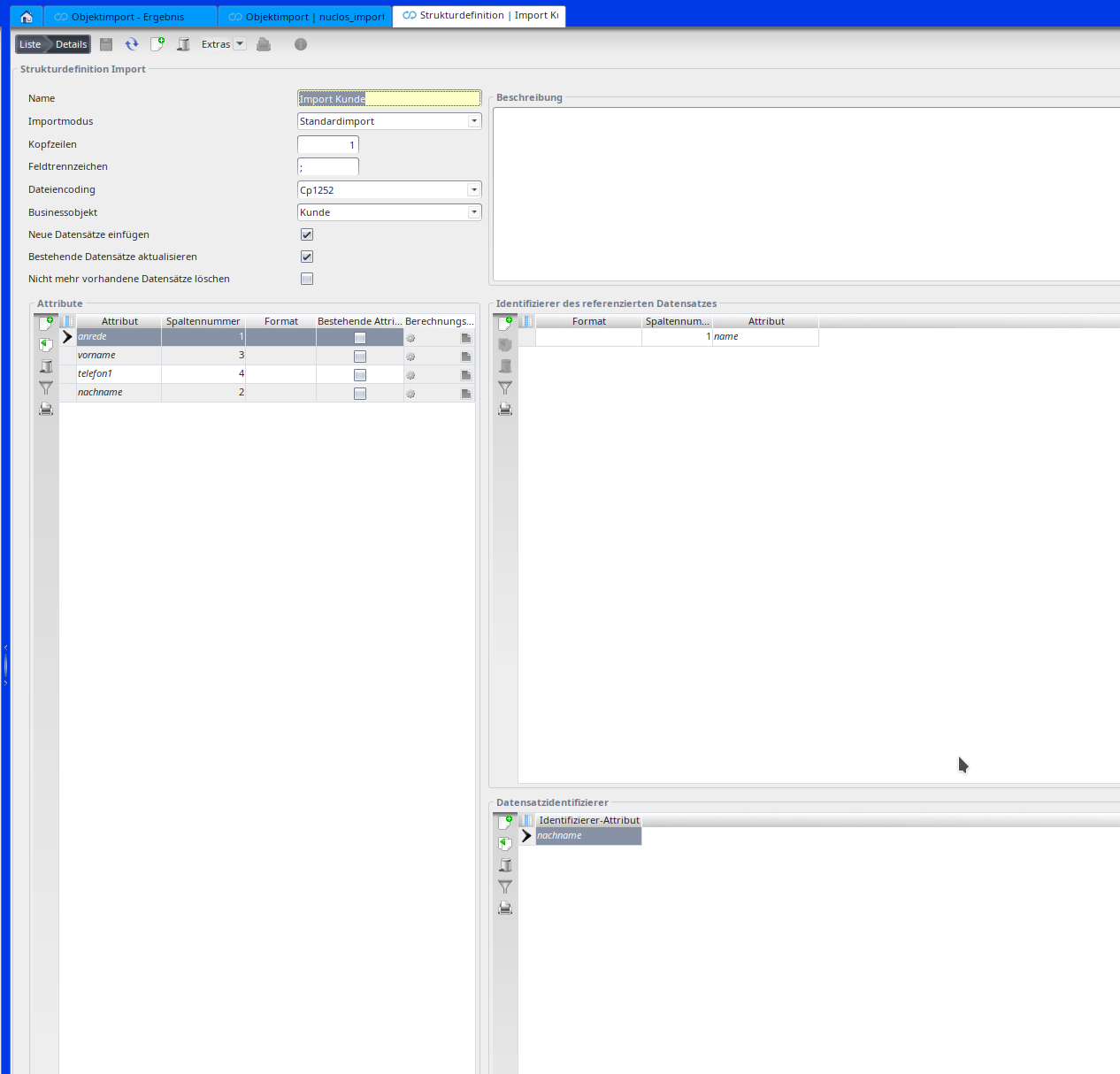
Structure definition for object import.
Mapping attributes
Link each BO attribute to the file's column number. Do not overwrite existing attributes limits overwriting per field. Boolean values recognise true/false, 1/0, y/n etc.
Calculation expression (Groovy)
Instead of a column number an attribute can be computed per row via a Groovy script. Available variables: values (String[], 0-indexed), line (Integer) and log (ImportLogger). If a script is set, no column number may be given.
if (values[2] == null || values[2].isEmpty()) {
    log.info("FALSE "+values[2]);
    return false;
} else {
    log.info("TRUE "+values[2]);
    return true;
}
Reference fields may only return Long, null or an empty string (≡ null):
if (values[0] == "Frau") {
    return 40000001;
}
else if (values[0] == "Herr") {
    return 40000002;
}
return null;
Date value:
java.text.SimpleDateFormat dateFormat = new java.text.SimpleDateFormat("dd.MM.yyyy");
java.util.Date date = dateFormat.parse("25.02.2020");

return date;
Format (parse string)
Only used when no script is set. Meaning per data type:
| Type | Format |
|---|---|
| String / number | <match>#<replacement> with regex; example Nr(\d)+#Nr $1: Nr9 → Nr 9. |
| Date | SimpleDateFormat; default dd.MM.yyyy. |
| Boolean / BigDecimal | format is not used. |
Identifiers
The identifier attribute marks a record as unique (important for updates). For reference fields the identifier of the referenced record defines via which field (and column number) the mapping to the referenced BO happens.
CSV format
Valid CSV (RFC 4180): fields may be double-quoted; fields with a line break or the field separator must be quoted; a " inside a value is escaped as "".
Related pages
Überblick
Inhalte