
Language: Deutsch · English
 3.1 SEPA: Direct debits
Prerequisites for the "direct debits" use case: the required business objects (debtors, reference objects, payment references) and their attributes.
REFERENZ INTEGRATORS STAND: JUL 2026 GILT FUER NUCLOS 4.2026.X
Auf dieser Seite
Machine-translated – under review
This page was machine-translated from German as a first draft and is currently under review. The authoritative source remains the German original (see the language switch above).
Direct debits
For the "direct debits" use case, the SEPA Nuclet requires the existence of three business objects that are taken into account in the SEPA exports:
- debtors ("Debitor")
- reference objects ("DebitorReference")
- payment references ("DirectDebitReference")
This triad of objects assumes that, in addition to debtors (e.g. customers) and references (e.g. invoices), there is a business object for explicit payment references (e.g. invoice line items).
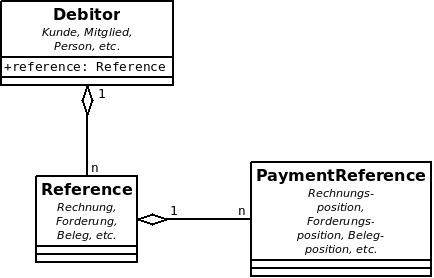
It is possible – and also intended by the Nuclet – to reduce this "triad" of objects to a "dyad" if there are no separate payment references in the target Nuclet.
In that case, for example, invoice and invoice line item coincide.
| Type | Description | Implementation with three entities | Implementation with two entities | Use case |
|---|---|---|---|---|
| Debtors | represents a person or company from which direct debits are to be collected | customer, member, person, etc. | customer, member, person, etc. | Direct debits |
| Debtor references | represents a direct-debit payment document | invoice, receivable, document, etc. | invoice, receivable, document, etc. | |
| Payment references | references/represents a concrete payment | invoice line item, receivable line item, document line item, etc. | invoice, receivable, document, etc. | |
| Creditors | represents a person or company to which credit transfers are to be made | supplier, customer, person, etc. | supplier, customer, person, etc. | Credit transfers |
| Creditor references | represents a credit-transfer payment document | incoming invoice, credit note, document, etc. | invoice, credit note, document, etc. | |
| Payment references | references/represents a concrete payment | invoice line item, credit-note line item, document line item, etc. | invoice, credit note, document, etc. |
Table 3: Prerequisites
3.1.1 Debtors
The existence of a debtor business object is required. Debtors represent customers, members, persons, etc.
The business object and attribute can be named arbitrarily in the target Nuclet. The connection is made through an interface that, in the current version, is implemented in a Java class.
| Attribute | Java data type | Nuclos data type | Required? | Unique? | Description |
|---|---|---|---|---|---|
| Name | String | Text | yes | no | serves as an identifying characteristic for the debtors |
| SEPA Mandate Identification | String | Text | yes, if the debtor is to be taken into account in SEPA exports | no | SEPA mandate identification |
| Date of SEPA Mandate Signature | Date | Date | yes, if the debtor is to be taken into account in SEPA exports | no | issue date of the SEPA mandate |
| Has SEPA Mandate Changed | Boolean | Yes/No | yes | no | indicates whether the SEPA mandate has changed on the debtor side |
| Is New Debitor Agent | Boolean | Yes/No | yes | no | indicates whether the bank on the debtor side has changed |
| SEPA Sequence Type | SEPASequenceType | Reference field | yes | no | SEPA sequence type (first, recurring, one-off) |
| BIC | String | Text | yes | no | BIC (Business Identifier Code, formerly: Bank Identifier Code) |
| IBAN | String | Text | yes | no | IBAN (International Bank Account Number) |
| Original Debitor Account | String | Text | no | no | provides the previous IBAN for SEPA mandate changes |
Table 3.1.1: Debtor business object
3.1.2 Reference objects
Reference objects represent payment documents that are to be taken into account in the SEPA exports. In the case of direct debits, these are e.g. invoices, receivables, documents or similar.
The business object and attribute can be named arbitrarily in the target Nuclet. The connection is made through an interface that, in the current version, is implemented in a Java class.
| Attribute | Java data type | Nuclos data type | Required? | Unique? | Description |
|---|---|---|---|---|---|
| Debitor | wrapper class | Reference field | yes | no | the debtor (customer, member, person, etc.) |
| Direct Debit Reference | String | Text | yes | no | an identifying characteristic for direct debits (e.g. the invoice number) |
| Reference Date | Date | Date | yes | no | a reference date (e.g. the invoice date) |
Table 3.1.2: Reference objects in the "direct debits" use case
3.1.3 Payment references
Payment references represent line items that are shown on the payment documents described in 3.2 with an explicit payment amount. If, for example, invoices are used as reference objects,
then the corresponding payment references would typically be the invoice line items.
The business object and attribute can be named arbitrarily in the target Nuclet. The connection is made through an interface that, in the current version, is implemented in a Java class.
| Attribute | Java data type | Nuclos data type | Required? | Unique? | Description |
|---|---|---|---|---|---|
| Reference | wrapper class | Reference field | yes | no | the parent reference object (in the case of invoice line items, this would be the invoice) |
| Amount | BigDecimal | Decimal (9,2) | yes | no | the amount to be paid (e.g. "invoice amount, gross") |
| SEPA Transaction | SEPATransaction | Reference field | no | no | reference to the transactions of a SEPA export (used to display the exported objects) |
| SEPA Export Date | Date | Date | no | no | export date |
Table 3.1.3: Payment references in the "direct debits" use case
Related pages
Überblick
Inhalte